
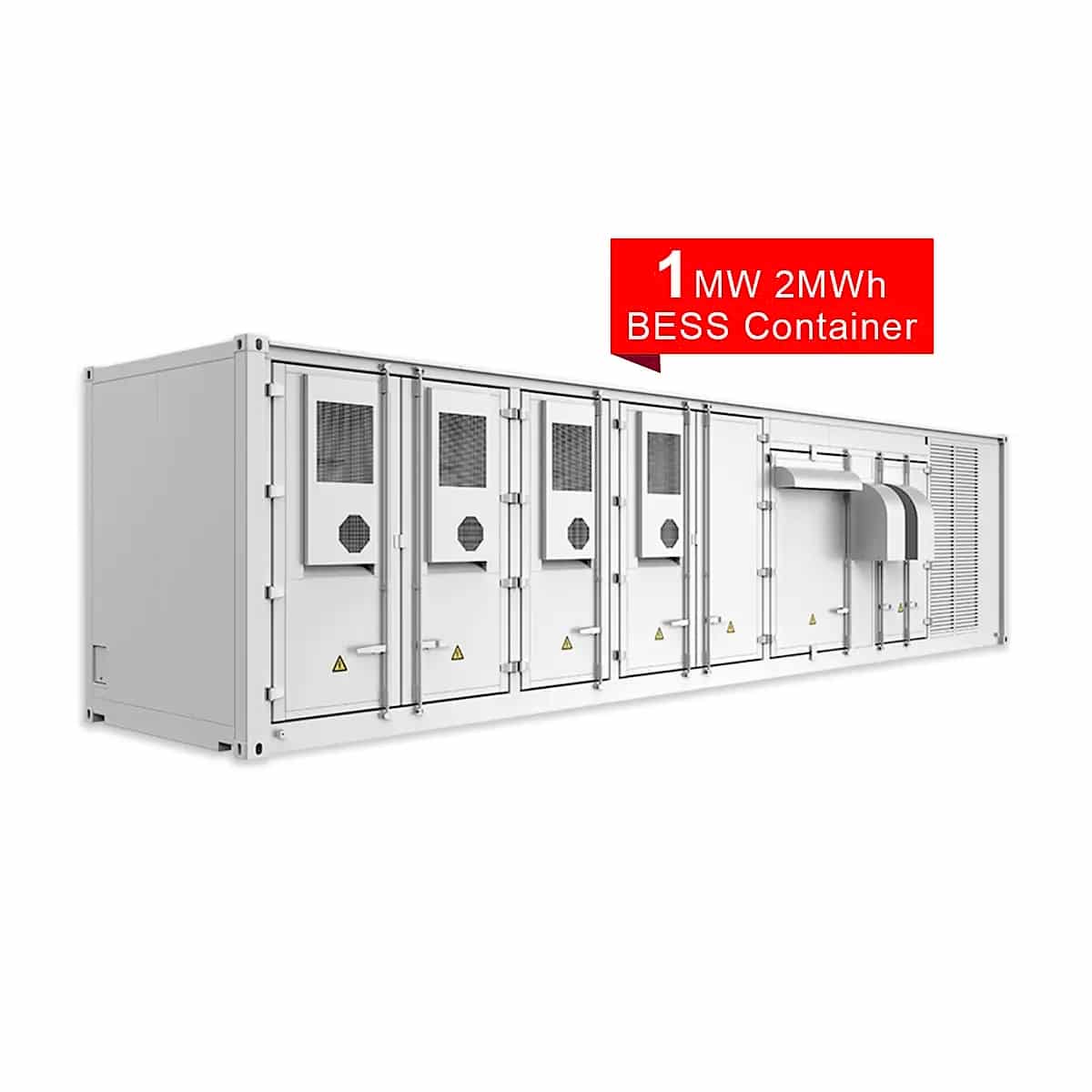
BESS Energy Storage Container System 500kW 1MW 1MWh 2MWh
Simplified Maintenance: Air cooling requires no complex liquid coolant loops, pumps or filters, resulting in lower maintenance requirements and reduced operational costs.
Faster Deployment: With fewer components to integrate on-site, the system can be operational in days rather than weeks.
Multiple working modes are available, which can be flexibly applied to various working scenarios.
Product Description
500kW/1MWh or 1MW/2MWh Air-Cooled Energy Storage Container is a highly integrated, turnkey solution designed for utility-scale, commercial, and industrial applications. Combining advanced lithium-ion battery technology with a reliable air-cooled thermal management system, this containerized unit offers a safe, efficient, and cost-effective way to manage energy, supporting grid stability, peak shaving, renewable integration, and backup power.
Integrated Modular Design
The system is pre-assembled in 20ft or 40ft energy storage container, combining battery racks, a bi-directional PCS, a local controller, and a fire suppression system. This plug-and-play design significantly reduces installation time, site civil works, and commissioning costs.
Efficient Air-Cooled Thermal Management
The intelligent forced-air cooling system maintains optimal operating temperatures across all battery cells. With multiple temperature sensors and variable-speed fans, it ensures minimal temperature variation between modules, maximizing cycle life and system reliability while keeping auxiliary power consumption low.
High Safety & Reliability
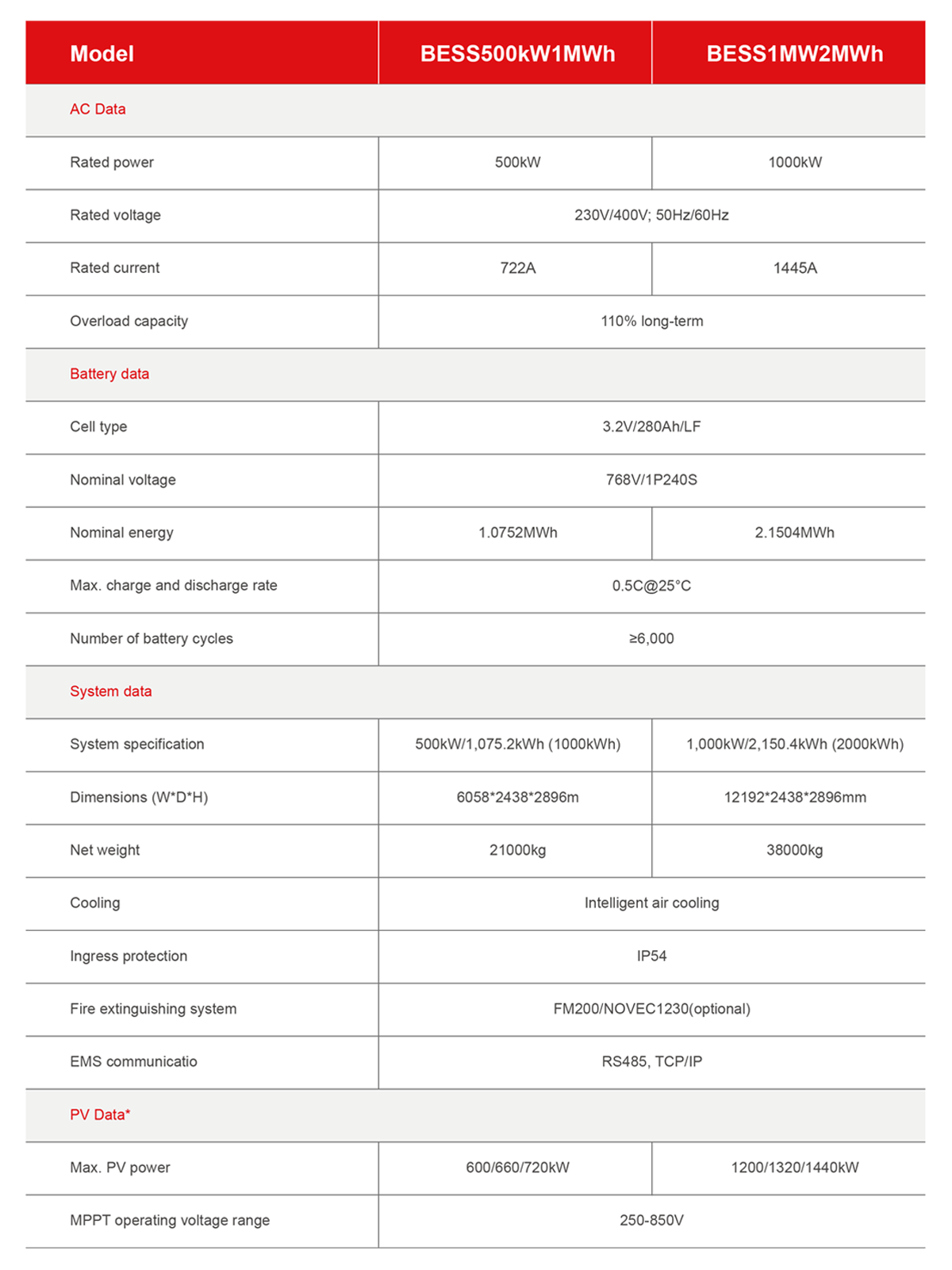
LFP Battery Chemistry: Provides superior thermal stability, longer cycle life (over 6,000 cycles at 80% DoD), and intrinsic safety compared to others.
Multi-Level Protection: Includes fuse protection, circuit breakers, and a three-level fire suppression system (aerosol or gas-based) compliant with NFPA 855 and local fire codes.
IP54 Enclosure: Designed for harsh outdoor environments, protecting against dust, rain, and corrosion.
Smart Energy Management
The container is equipped with Energy Management System (EMS) that supports:
Peak shaving and load leveling;
Frequency regulation and grid support;
Renewable energy time-shifting (solar/wind);
Black start and backup power;
Remote monitoring and OTA (Over-the-Air) updates via cloud platform.
Application Scenarios
Renewable Integration: Smooths fluctuations from solar and wind farms, reducing curtailment.
Peak Shaving: Reduces demand charges for industrial and commercial facilities by discharging during peak hours.
Grid Support: Provides frequency regulation, voltage support, and reserve capacity to enhance grid stability.
Microgrids: Serves as the primary energy storage unit in off-grid or islanded microgrid systems.
Backup Power: Ensures uninterrupted power supply for critical infrastructure.
FAQ
1MW/2MWh energy storage container is a large-scale battery system designed to store and deliver electrical energy. The “1MW” refers to its power output capacity (1 megawatt), meaning it can discharge electricity at a rate of 1 MW. The “2MWh” indicates its energy storage capacity (2 megawatt-hours), meaning it can supply 1 MW for 2 hours or adjust output proportionally (e.g., 0.5 MW for 4 hours). It typically uses lithium-ion or other advanced battery technologies and is housed in a standardized shipping container for easy transport and installation.
This system is versatile and can be used for:
Peak Shaving: Reducing electricity costs by discharging stored energy during high-demand periods.
Renewable Integration: Storing excess solar or wind energy for use when generation is low.
Grid Stabilization: Providing frequency regulation and backup power to enhance grid reliability.
Microgrids & Off-Grid Power: Supporting remote or industrial sites with stable energy supply.
Scalability: Multiple units can be combined for larger capacity.
Mobility: Pre-assembled in shipping containers for quick deployment.
Safety: Built-in battery management systems (BMS), fire suppression, and climate control.
Cost-Effective: Reduces infrastructure costs compared to custom-built solutions.
Plug-and-Play: Simplified installation and integration with existing power systems.