
As renewable energy penetration grows, energy storage systems (ESS) have become essential for grid stability, peak shaving, and self-consumption optimization. Two dominant architectural approaches exist: AC-coupled and DC-coupled storage systems.
AC Coupled Energy Storage System
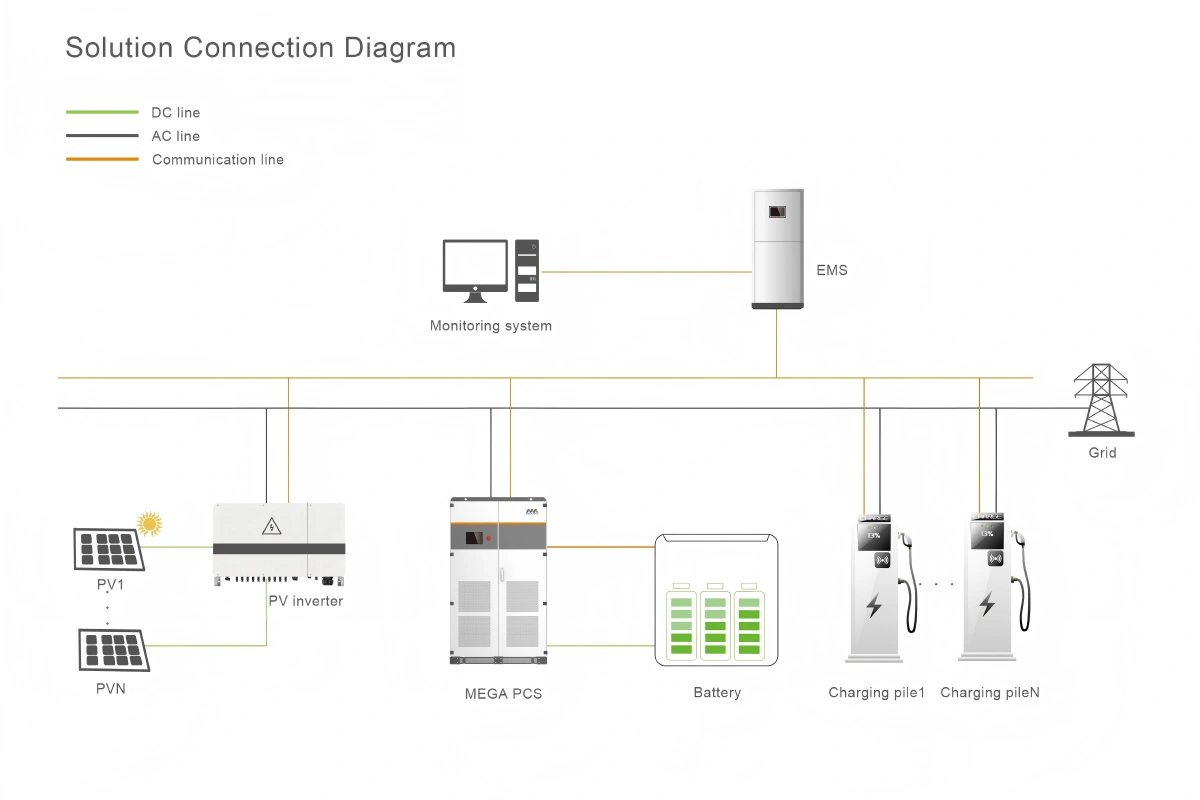
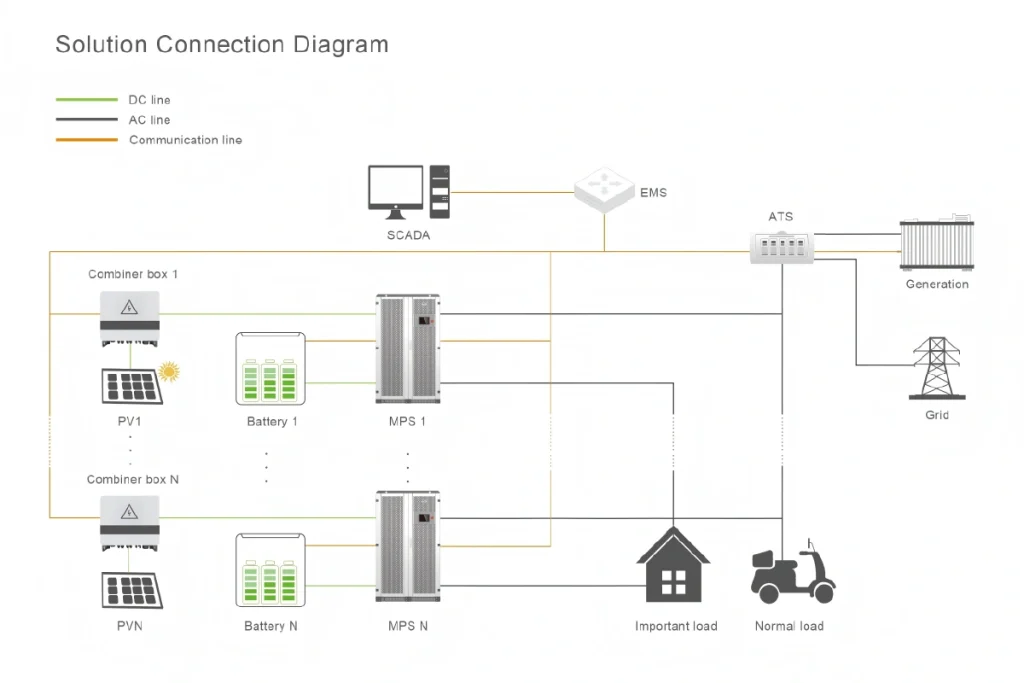
In an AC coupled system, the battery storage is connected to the alternating current (AC) side of the power system. Typically, this involves a separate battery inverter that interfaces with the AC bus, alongside solar inverters (or grid-tied inverters) and possibly a grid connection. The power flow from solar panels is converted from DC to AC by the solar inverter, then converted back to DC by the battery inverter for charging; when discharging, the battery’s DC power is inverted to AC for loads or grid export.
Key components: Solar PV array + solar inverter (DC-AC) + battery bank + battery inverter (bi-directional DC-AC) + AC distribution panel.
Advantages:
Retrofit-friendly: Easily added to existing grid-tied solar systems without modifying the solar inverter.
Standardized components: Uses off-the-shelf battery inverters compatible with many battery types.
Flexibility: Can support AC-coupled solar, wind, or even diesel generators on the same AC bus.
Scalability: Multiple battery inverters can be paralleled for larger capacity.
Disadvantages:
Lower round-trip efficiency: Because of double conversion (PV DC → AC → battery DC, then back to AC for loads), typical efficiency drops to 85–90%.
Higher component cost: Requires a dedicated battery inverter plus the solar inverter.
Complex control: Energy management must coordinate two separate inverters.
AC Coupled Applications:
Retrofit of grid-tied solar homes: Homeowners with existing solar inverters can add storage without replacing equipment, minimizing disruption.
Utility-scale storage: Large battery systems (e.g., 10+ MW) often connect at the AC side of a solar farm or substation, allowing independent operation and grid services.
Hybrid microgrids: Where wind turbines, diesel gensets, and solar coexist, AC coupling allows all sources to share a common AC bus, simplifying integration.
Backup power with multiple inverters: AC coupling can use a “grid-forming” battery inverter to create a microgrid during outages, while solar inverters follow the AC signal.
DC Coupled Energy Storage System
In a DC coupled system, the battery is connected to the DC side of the solar PV system, usually via a DC-DC converter, sharing a common DC bus with the solar array. A single hybrid inverter (or a bi-directional inverter) handles both solar and battery power, converting the combined DC power to AC for loads or grid export.
Key components: Solar PV array + battery bank + DC-DC converter (for battery) + hybrid inverter (DC-AC) + optional DC combiner.
Advantages:
Higher efficiency: Only one DC-AC conversion for solar-to-load or solar-to-battery paths. Typical round-trip efficiency for stored solar energy: 93–97%.
Lower system cost: Fewer components (no separate solar inverter and battery inverter) reduce hardware and installation costs.
Simpler energy management: Single inverter controls all power flows.
Better for new installations: Ideal for new solar+storage systems.
Disadvantages:
Limited retrofit options: Cannot be easily added to an existing AC solar system without replacing the solar inverter with a hybrid model.
Less flexibility: DC bus voltage must match battery and PV string characteristics; adding other generators (e.g., wind) is more difficult.
Higher DC-side losses: Long DC cable runs can be problematic compared to AC coupling.
DC Coupled Applications:
New residential solar+storage: Most modern home batteries (e.g., Tesla Powerwall 2/3, Enphase IQ Battery) use DC coupling with a hybrid inverter for highest self-consumption and backup efficiency.
Off-grid systems: For cabins, remote telecom towers, or villages, DC coupling minimizes conversion losses, crucial when energy is scarce.
DC microgrids: In data centers or electric vehicle charging hubs with DC loads, DC-coupled storage avoids unnecessary AC conversion.
Solar carports + EV charging: DC-coupled storage can directly charge EVs via DC chargers, improving efficiency.