
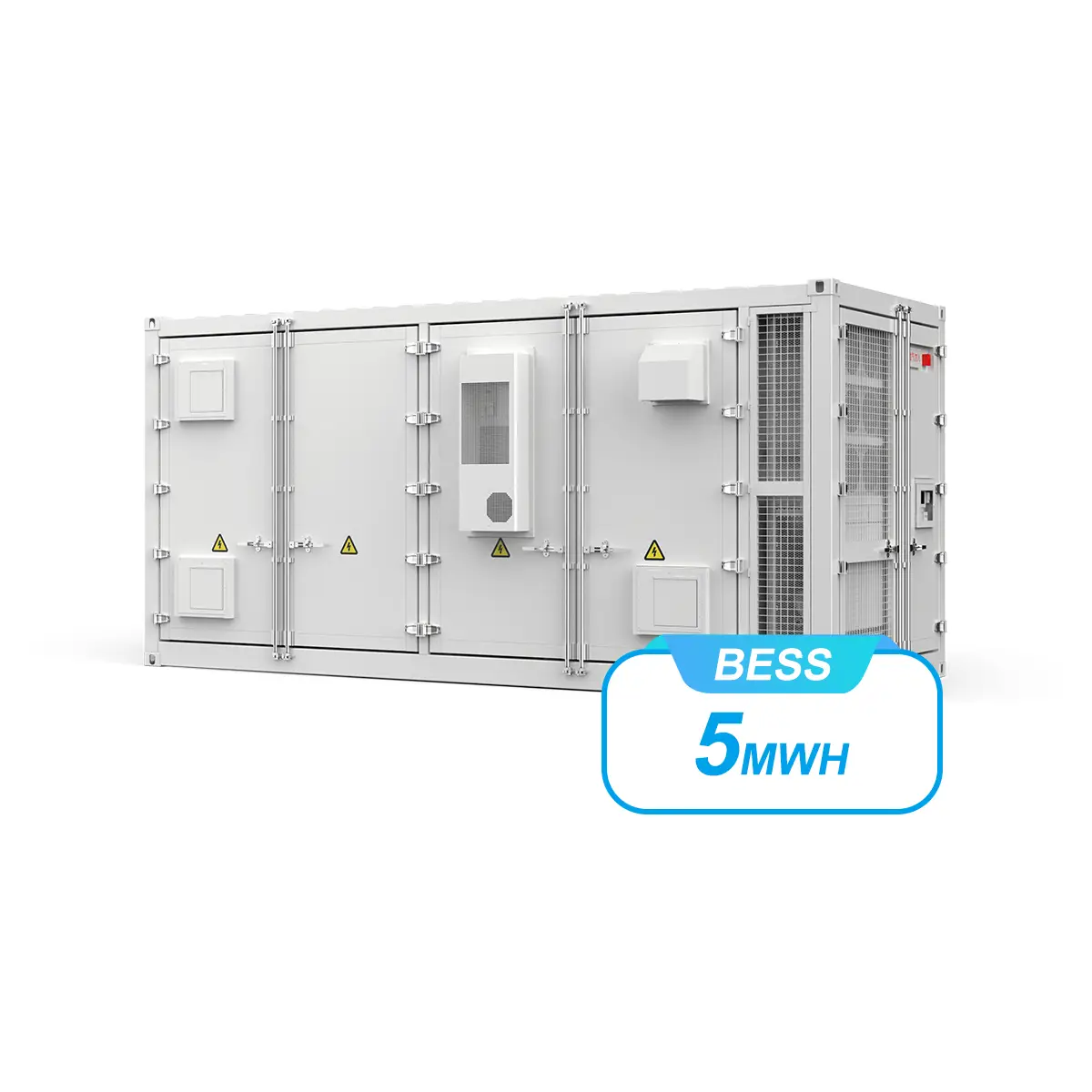
Utility Scale 5MWh Energy Storage System for Microgrids
Superb safety
Triple fire protection measures guarantee early detection, accurate spraying, and rapid fire suppression throughout the entire process.
High economic efficiency
315 Ah LFP cells with high energy density and prolonged cycle life realize a cost reduction per kWh of 30%.
Increasing flexibility
Flexible system topology for various scenarios, including the power generation side, grid side, and user side.
Product Description
The transition to renewable energy demands reliable, high-capacity storage solutions that can stabilize the grid, integrate solar and wind power, and deliver consistent performance under varying conditions. Our 20ft Liquid-Cooled 5MWh Battery Energy Storage System (BESS) represents the forefront of containerized energy storage technology—combining high energy density, intelligent thermal management, and multi-layered safety in a compact, pre-engineered footprint.
Designed for utility-scale projects, commercial and industrial applications, and microgrid deployments, this 5MWh BESS container delivers 35% more capacity than previous-generation models in the same 20ft form factor, significantly reducing land occupancy and installation costs.
High-Density Energy Storage in a Compact Footprint
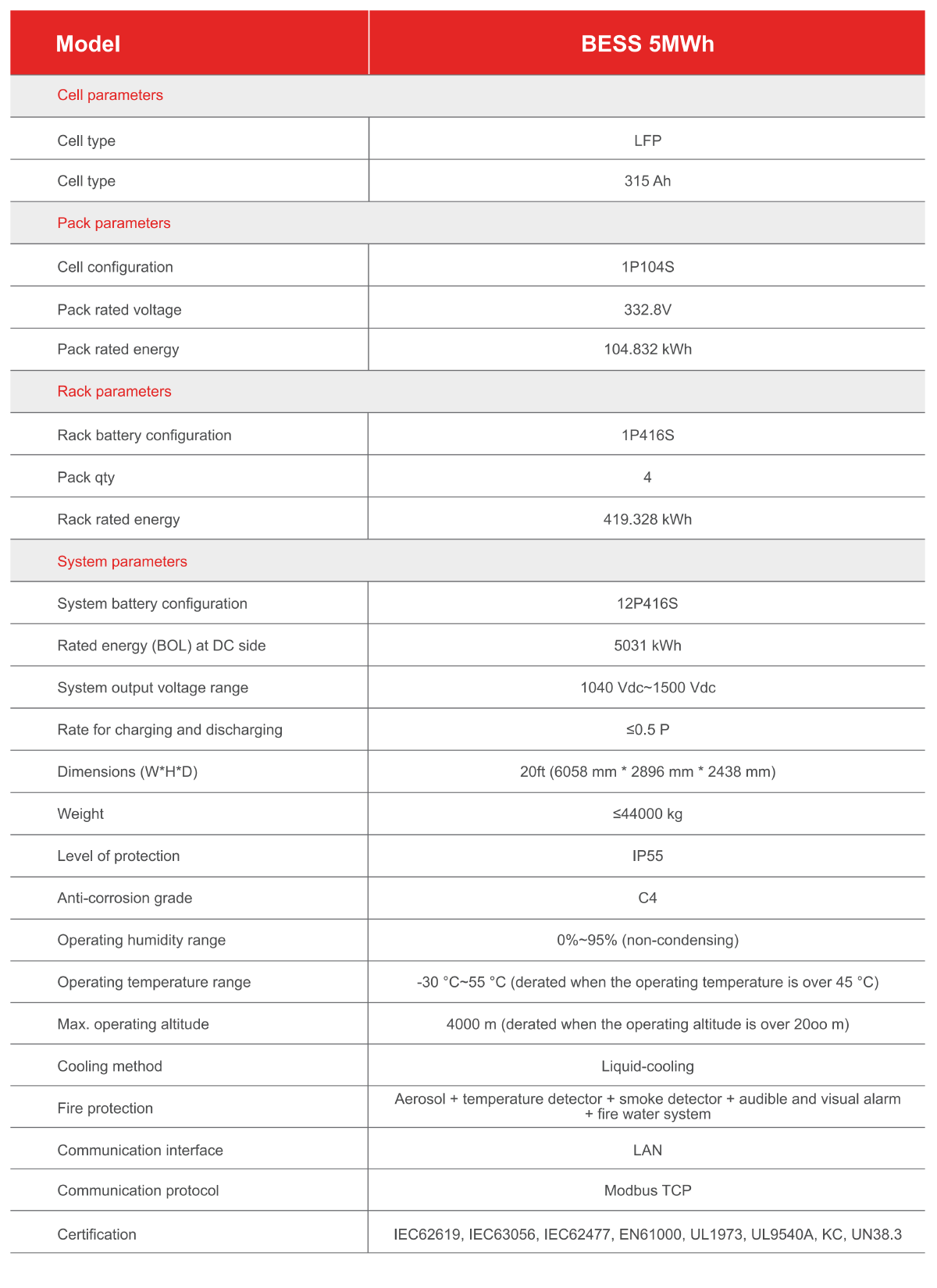
The 5MWh BESS container integrates advanced 315Ah lithium iron phosphate (LFP) prismatic cells, renowned for their safety, longevity, and thermal stability . The system achieves: 5,031 kWh rated energy capacity within a standard 20ft container;
30% higher energy density compared to conventional air-cooled systems, enabled by innovative dual-row layout and liquid cooling technology;
40% reduction in project area through space-efficient design, lowering civil works and land acquisition costs;
12P416S configuration with 48 battery modules, delivering nominal voltage of 1,331.2V and operating range of 1,040V–1,500V DC.
Advanced Liquid Cooling Thermal Management
Effective thermal regulation is critical for battery performance and lifespan. Our variable-frequency liquid cooling system maintains optimal operating temperatures with exceptional precision:
Temperature differential ≤2.5°C across all battery modules, ensuring uniform aging and maximizing cycle life;
Active coolant circulation through each battery rack provides superior heat dissipation compared to air cooling, with cooling capacity independent of ambient conditions;
Automated coolant management reduces maintenance requirements and ensures consistent performance from -30°C to +55°C operating range;
40% reduction in auxiliary power consumption versus traditional HVAC systems, improving overall system efficiency.
Comprehensive Multi-Level Safety Architecture
Safety is engineered at every level—from cell chemistry to system-level protection:
Cell-Level Safety
Thermally stable LFP chemistry eliminates cobalt and resists thermal runaway;
Aerogel insulation between cells prevents propagation of thermal events;
Real-time cell voltage and temperature monitoring with ms-level response.
Module & Rack Protection
Pack-level aerosol fire suppression integrated into each battery module;
Individual rack-level HV boxes with automatic disconnectors;
Dedicated cell monitoring and protection per module;
Container-Level Systems
Triple-layer fire protection: smoke detectors, temperature sensors, and aerosol suppression with fire water interface;
2-hour fire-resistant enclosure design compliant with NFPA 855 and UL 9540A;
Explosion relief panels meeting NFPA68 standards;
IP55 ingress protection and C4/C5 corrosion resistance for outdoor installation
Intelligent Battery Management & System Integration
Smart controls maximize performance, extend battery life, and simplify operation:
Active balancing technology continuously redistributes charge between cells, achieving 23× higher balancing efficiency than passive systems and extending battery life by over 10%;
Rack-level energy management optimizes performance and enables flexible system configuration;
Multi-level communication via LAN, Modbus TCP, and optional IEC 61850 protocol for seamless SCADA integration;
Real-time monitoring of each cell’s health, temperature, and performance through HMI interface with remote access capability;
0.5P charge/discharge rate supporting 2-hour applications, with flexibility for 1 hour to 4 hour configurations.
Simplified Logistics & Rapid Deployment
Pre-engineered and factory-tested, our 5MWh container minimizes on-site work and accelerates project timelines:
Standard 20ft ISO container footprint simplifies transportation worldwide;
Single-door access for rapid installation and simplified maintenance;
Modular design allows up to 4 containers connected to a single PCS, supporting 2–8 hour applications;
Pre-configured and validated systems reduce commissioning time by up to 50%;
Weight approximately 43–45 tons, suitable for standard handling equipment.
Comprehensive Support & Services
We partner with you throughout your project lifecycle:
Pre-Sales Engineering: Site-specific configuration and system design;
Factory Acceptance Testing: Validated performance before shipment;
Logistics Coordination: Global shipping expertise;
Installation Supervision: On-site technical support;
Commissioning Services: Professional startup and validation;
Training: Operator training for your team;
Warranty & After-Sales: Long-term support and spare parts.
FAQ
Liquid cooling offers three main advantages:
Uniform temperature: Maintains ≤2.5°C temperature difference across all cells, preventing hot spots and ensuring uniform aging.
Higher efficiency: Reduces auxiliary power consumption by up to 40% compared to HVAC‑intensive air cooling.
Higher energy density: Enables more cells in the same footprint, increasing capacity without enlarging the container.
The container arrives fully assembled and factory‑tested. On‑site steps:
Position the container on a prepared concrete pad.
Connect DC cabling to the external Power Conversion System (PCS) and AC side to the grid/load.
Connect communication cables (Ethernet, Modbus) to the monitoring system.
Perform system configuration and final validation with our technical support.
Typical commissioning time is 1–2 weeks.
The system is designed for minimal maintenance:
Battery management: The BMS automatically balances cells and reports health data; no routine cell maintenance needed.
Cooling system: The liquid cooling loop is sealed – periodic visual checks of coolant level and connections (every 6–12 months) are sufficient.
Annual inspections: Recommended to verify safety devices, clean external vents, and update software if needed.