
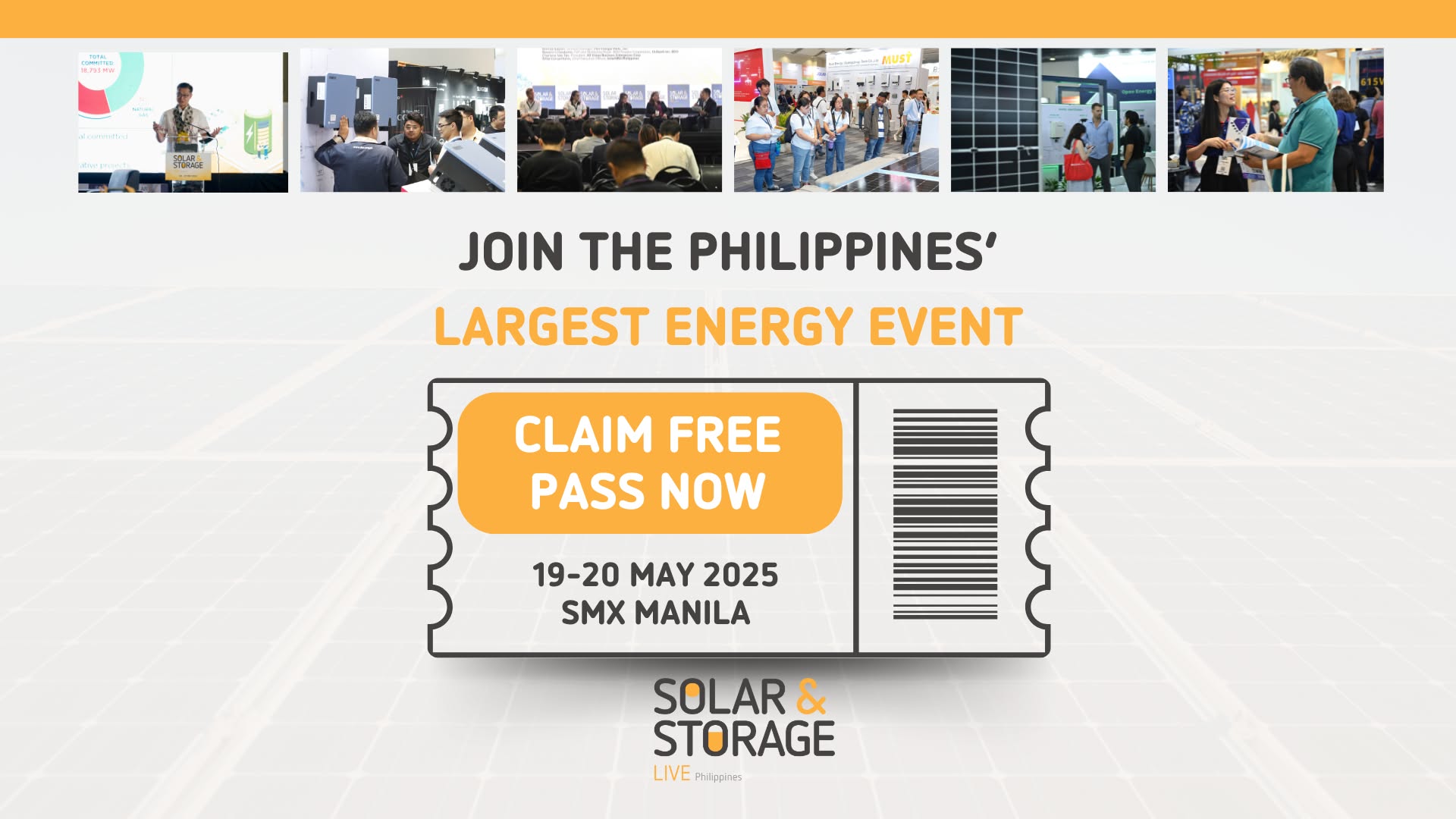
Manila — As the Philippines faces intensifying power supply pressures and rising energy demand, the country’s largest clean energy gathering, Solar & Storage Live Philippines 2026, returns to Manila from May 19 to 20 at the SMX Convention Center.
Now in its 12th edition, this free-to-attend exhibition and conference expects to welcome over 18,000 energy professionals, alongside more than 350 sponsors and exhibitors and 150 expert speakers, making it the definitive annual marketplace for the Philippines‘ solar and energy storage industry.The event is supported by leading industry organizations across the energy sector, including ASIP, CREST, ENPAP 4.0, IIEE, IPPF, PSSEA, The CentRE, and UPEEP, ensuring strong representation across the entire ecosystem.
Discussions will cover a wide range of critical topics across eight conference tracks, including large-scale solar, C&I rooftop solar, residential solar, energy storage and battery systems, rural electrification, EVs and EV infrastructure, as well as the broader future energy landscape.Attendees can also gain practical knowledge through expert-led workshops at the Solar Installer University, covering system design, BESS integration, installation best practices, safety standards, and troubleshooting.
“There’s more interest than ever before in the opportunities in the Filipino market and there‘s no better place to explore how you can be a part of it,” said Paul Clark, Managing Director of Terrapinn Pte Ltd. “The importance of energy security is front-of-mind for experts across the world right now – and we’re delighted that Solar & Storage Live Philippines can help contribute to that debate.”
Growing Power Supply Pressures
The event comes at a critical moment. The National Grid Corporation of the Philippines (NGCP) recently placed both the Luzon and Visayas grids under red alert as power supply reserves fell short of peak demand.Energy authorities have warned that yellow and red alerts may persist in the coming months, with Filipinos braced for further rotational brownouts.
Multiple generating units remain offline. NGCP reported that 17 power plants in Luzon have been on forced outage since March 2026, with an additional three offline since 2025, two since 2024, and one since 2019. Fourteen other plants are operating on derated capacities, leaving a combined 4,242.5 MW unavailable to the grid.In the Visayas, 11 plants have been on forced outage since March 2026, with four offline since 2025, two since 2024, two since 2023, and one since 2021.
The power shortages have already inflicted economic consequences. The Philippine Chamber of Commerce and Industry (PCCI) warned that the first red alert of 2026 left more than 200,000 businesses and households without electricity, with the country’s GDP expanding only 2.8 percent in Q1 2026 and inflation projected to reach 6.3 percent.More than 920,000 customers were affected within the Manila Electric Company (Meralco) franchise area alone during the grid alerts.
Beyond generation shortages, analysts point to deeper structural weaknesses: the grid remains overly dependent on a small number of large power plants and key transmission lines, making it vulnerable to cascading failures.
Policy Response and the Role of Storage
In response, the government has moved to accelerate renewable energy deployment and strengthen grid reliability. The Department of Energy (DOE) announced that 22 power projects with a combined capacity of 1,471 MW are being fast-tracked for grid entry by April 2026, with 12 solar power plants contributing about 1,284 MW of that capacity.
More significantly, the DOE issued Department Circular No. DC2026-02-0008, requiring all variable renewable energy (VRE) plants with a capacity of 10 MW or higher to integrate energy storage systems (ESS) equivalent to at least 20% of the plant‘s installed capacity.“Energy storage is not only about storing surplus energy, it is about strengthening the grid’s capability to absorb more renewables while maintaining reliability,” said Energy Secretary Sharon S. Garin. This policy framework marks a defining shift in how the Philippines manages the inherent intermittency of solar and wind power.
A Timely Industry Gathering
Solar & Storage Live Philippines 2026 provides a critical platform where business, policy, and technology converge at a moment when the country is urgently seeking solutions to meet rising demand and stabilize its power system.The exhibition will feature more than 350 brands showcasing advancements in photovoltaic technology, battery energy storage systems (BESS), inverters, mounting structures, and smart energy solutions.Storage has become a focal point for Philippine utilities and regulators, who increasingly view it as the primary solution for stabilizing a grid reliant on intermittent solar power.
The Department of Energy‘s policy requiring energy storage for all new large-scale VRE projects could unlock significant market opportunities for storage providers, system integrators, and technology developers — all of which will be on full display at the Manila event.With utility-scale projects requiring billions of pesos in investment, the summit provides transparency for lenders and developers to align on the next phase of the energy transition.
As climate-driven heatwaves and economic growth push electricity consumption to new peaks, energy storage solutions have moved from an optional upgrade to a critical necessity for grid stability. Solar & Storage Live Philippines 2026 arrives at precisely the right moment — offering the platform where technology providers, policymakers, and investors can meet to shape the country’s energy future.
Are you looking for home solar pv system or industrial battery storage system? don’t hesitate to contact us!